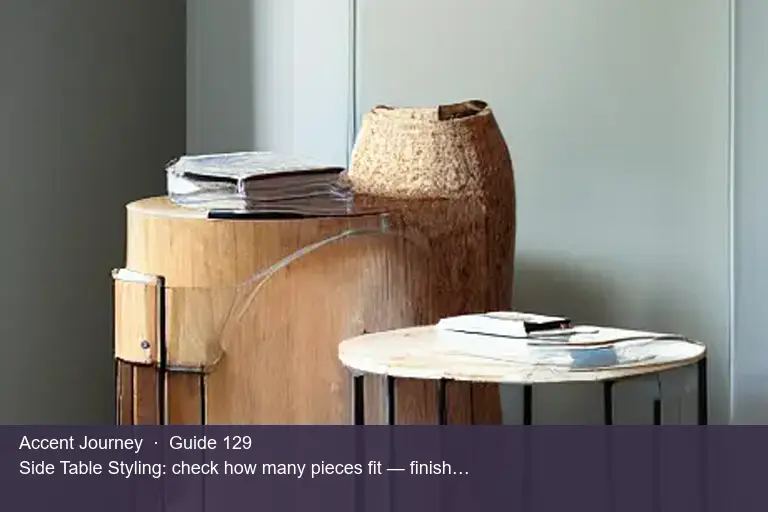
Side Table Styling: check how many pieces fit — finish criteria for existing decor; setup for independent projects
**Side Table Styling: Check How Many Pieces Fit — Finish Criteria for Existing Decor; Setup for Independent Projects**
In an era where side tables have become integral elements in furniture design, the ability to determine how many pieces fit into the overall scheme is essential. This task, while not requiring extensive knowledge, can be immensely rewarding for those who are dedicated to the art of furniture construction. Whether you are a DIY enthusiast or a seasoned professional, understanding how to measure and fit pieces into the existing decor can significantly enhance your project's appeal and effectiveness.
**Step 1: Determine the Number of Pieces Required**
Before you start measuring, it's important to understand how many pieces of furniture you need in the existing decor. This will guide your measurements and ensure that you have the right pieces to fit your design. For instance, if you are using a modern, minimalist design, you may need fewer pieces than a more elaborate piece of furniture.
**Example:**
Imagine you have a space that is predominantly white and neutral in color. If you are using a side table as the centerpiece of your living room, you may need fewer pieces. The most basic side tables could fit two to three pieces, depending on the size of your room and the furniture you have. However, if you are using a more sophisticated design, like a living wall or a large coffee table, you may need several pieces to complete the arrangement.
**Step 2: Gather the Pieces**
Once you have determined how many pieces you need, gather the pieces that will make up the side table. This might involve purchasing additional pieces or creating your own custom pieces. Ensure that you have all the pieces you need before you begin measuring.
**Step 3: Measure the Pieces**
Using a straightedge and a tape measure, measure the dimensions of the pieces you have. If you are using a piece of furniture, ensure that you measure the height, width, and depth of the piece. If you are using a piece of art or decorative fabric, measure the length and width of the piece.
Let's say you have a side table that is a 60-inch wide and 30-inch deep. If you are using a piece of art or decorative fabric, you might measure the length and width of the fabric, as well as the height and width of the piece.
**Step 4: Check the Fit**
Once you have gathered the measurements, check the fit of the pieces in the existing decor. This can be done by comparing the measurements of the pieces with the dimensions of the existing decor. If the pieces fit perfectly, you have a successful side table.
If you are using a side table that is 60 inches wide and 30 inches deep, and the existing decor is 66 inches wide and 40 inches deep, you can see that the pieces fit perfectly, completing the side table design.
**Step 5: Set Up for Independent Projects**
Once you have measured and checked the fit of the pieces in the existing decor, you can move on to setting up for independent projects. This involves organizing the pieces in a way that allows you to work on different sections of the furniture in the space. For instance, if you are using a side table, you might want to divide the space into sections like a living room or a dining area, each with its own side table.
If you are using a side table that is a 60-inch wide and 30-inch deep, you might divide the space into sections like a living room and a dining area. In the living room, you might have a side table that is 60-inch wide and 30-inch deep, and in the dining area, you might have a side table that is 60-inch wide and 30-inch deep.
**Conclusion**
By following these steps, you can check how many pieces fit into the existing decor, determine the number of pieces required, gather the pieces, measure the pieces, check the fit, and set up for independent projects. With these steps, you can create a side table that is both functional and aesthetically pleasing.