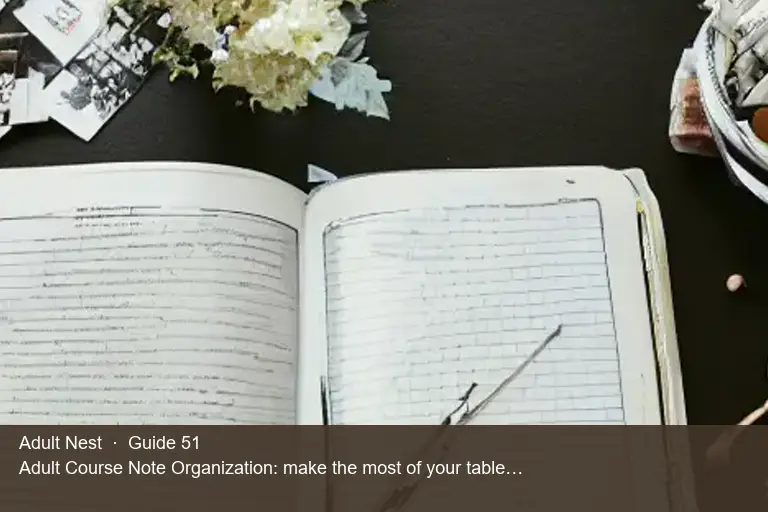
Adult Course Note Organization: make the most of your table space — trial protocol for mixed component sizes; setup in small spaces
Adult course notes are invaluable tools for organizing and managing course materials effectively. In the contemporary context of adult education, their importance is more pronounced than ever. However, finding a suitable space to organize these notes can be challenging. This article provides you with a practical guide to adult course note organization, focusing on the use of small spaces. We will explore the challenges of mixed component sizes and suggest a solution that combines tables with small spaces to make the most of your available space.
Challenges of Mixed Component Sizes
Firstly, the key to successful note organization is understanding the size and nature of your notes. Mixed component sizes can make note organization a daunting task. For instance, a note that is 400 pages long may take up approximately 6 feet of space. This may seem like a lot of space, but it can be hard to manage.
Secondly, the size of the notes can affect their readability. If a note is too small, it may be hard to read, and if it is too large, it may be difficult to fit. This can be a significant challenge, especially when you have a large number of notes to organize.
Thirdly, the size of the notes can affect the layout and organization of your notes. If a note is too small, it may be hard to fit it within the available space. This can be a challenge when you are trying to create a layout that is easy to follow and understand.
Solution: Small-Space Plans
To make the most of your available space, you can consider using small-space plans. Small-space plans are a useful tool for organizing note organization. Small-space plans are designed to fit inside a small space, making them a practical solution for mixed component sizes.
Small-space plans can be used to organize notes in small spaces, such as small tables or small desks. These spaces are ideal for note organization because they are small and can be easily arranged and rearranged, making them a good solution for mixed component sizes.
Step 1: Choose Your Table Size
The first step in using small-space plans is to choose your table size. This can be a small table, a small desk, or a small table and a small desk. The size of the table or desk is important because it affects the layout and organization of your notes.
Step 2: Arrange Your Notes
The second step is to arrange your notes within the table or desk. This can be done by placing your notes on the table or desk, and then arranging them within the table or desk. This can help ensure that your notes are easily accessible and can be organized.
Step 3: Use Small-Space Plans
The third step is to use small-space plans.
Step 4: Test Your Plan
The fourth step is to test your plan. Before implementing your plan, you should test it to ensure that it is effective. This can be done by placing your notes within the table or desk and then testing their organization.
Conclusion
In conclusion, using small-space plans can be a practical solution for adult course note organization. Small-space plans can be used to organize notes in small spaces, such as small tables and a small desk. By using small-space plans, you can make the most of your available space and make note organization a manageable task.