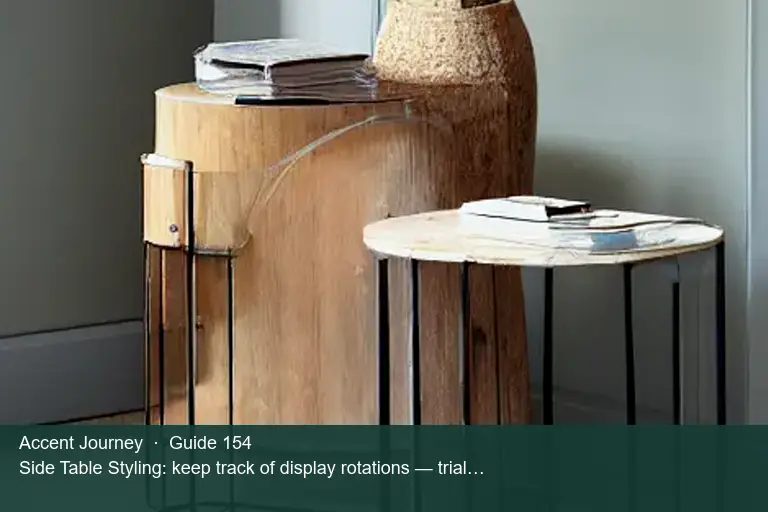
Side Table Styling: keep track of display rotations — trial protocol for incomplete measurements; setup for independent projects
Side tables in the home serve as functional furniture that can be used for various purposes, such as displaying items, serving as a seating area, or as storage. When choosing the right side table, it’s essential to consider the display rotations to ensure the table is used efficiently. In this article, we will discuss how to keep track of display rotations for side table styling, provide an example, and outline a trial protocol for incomplete measurements.
### Understanding Side Table Display Rotations
In a side table, the display rotations are the angles at which items are displayed, such as books, plants, or other decorative items. These rotations help maintain the aesthetic appeal and functionality of the table. For example, a book placed at a 45-degree angle will be displayed in a way that’s more visually pleasing, while a plant placed at a 30-degree angle might be more aesthetically pleasing.
### Common Misunderstandings: How to Keep Track of Display Rotations
- **Misunderstanding:** "I just need to keep track of display rotations to ensure my side table looks better."
- **Correct Answer:** It’s essential to consider the display rotations to ensure the table is used efficiently, not just for aesthetic purposes. The goal is to maintain the aesthetic appeal and functionality of the table, not to make it look better.
- **Misunderstanding:** "I don’t have time to keep track of display rotations."
- **Correct Answer:** While it may be challenging to keep track of display rotations, it’s not impossible. The key is to make the necessary adjustments at the right time, and not to neglect any aspect of the table.
### Example: Side Table Styling
To keep track of display rotations for a side table, it’s useful to consider the angle at which items are displayed. For instance, a book placed at a 45-degree angle will be displayed in a way that’s more visually pleasing, while a plant placed at a 30-degree angle might be more aesthetically pleasing.
### Trial Protocol for Incomplete Measurements
To keep track of display rotations for side table styling, it is important to have a trial protocol for incomplete measurements. This protocol should involve the following steps:
- **Measurement:** Measure the angle at which items are displayed, such as books or plants.
- **Consideration:** Consider the angle at which items are displayed and decide whether to keep track of display rotations or not.
- **Adjustment:** Adjust the display rotations at the right time, depending on the angle at which items are displayed.
### Trial Protocol
Here’s a trial protocol for incomplete measurements:
**Step 1: Measurement**
Measure the angle at which items are displayed, such as books or plants.
**Step 2: Consideration**
Consider the angle at which items are displayed and decide whether to keep track of display rotations or not.
**Step 3: Adjustment**
Adjust the display rotations at the right time, depending on the angle at which items are displayed.
### Conclusion
To keep track of display rotations for side table styling, it’s essential to consider the angle at which items are displayed and decide whether to keep track of display rotations or not. By having a trial protocol for incomplete measurements, it is possible to keep the table functioning efficiently and maintain the aesthetic appeal of the table.
Remember, the goal is to maintain the aesthetic appeal and functionality of the table, not to make it look better. The key is to make the necessary adjustments at the right time, not to neglect any aspect of the table.